NFStream: a Flexible Network Data Analysis Framework.
pip install nfstream
NFStream is a multiplatform Python framework providing fast, flexible, and expressive data structures designed to make working with online or offline network data easy and intuitive. It aims to be Python's fundamental high-level building block for doing practical, real-world network flow data analysis. Additionally, it has the broader goal of becoming a unifying network data analytics framework for researchers providing data reproducibility across experiments.
| Live Notebook |

|
| Project Website |

|
| Discussion Channel |

|
| Latest Release |

|
| Supported Versions |


|
| Project License |

|
| Continuous Integration |



|
| Code Quality |


)
|
Table of Contents
- Table of Contents
- Main Features
- How to get it?
- How to use it?
- Building from sources
- Contributing
- Ethics
- Credits
- Publications that use NFStream
- License
Main Features
- Performance: NFStream is designed to be fast: AF_PACKET_V3/FANOUT on Linux, multiprocessing, native CFFI based computation engine, and PyPy full support.
- Encrypted layer-7 visibility: NFStream deep packet inspection is based on nDPI. It allows NFStream to perform reliable encrypted applications identification and metadata fingerprinting (e.g. TLS, SSH, DHCP, HTTP).
- System visibility: NFStream probes the monitored system's kernel to obtain information on open Internet sockets and collects guaranteed ground-truth (process name, PID, etc.) at the application level.
- Statistical features extraction: NFStream provides state of the art of flow-based statistical feature extraction. It includes post-mortem statistical features (e.g., minimum, mean, standard deviation, and maximum of packet size and inter-arrival time) and early flow features (e.g. sequence of first n packets sizes, inter-arrival times, and directions).
- Flexibility: NFStream is easily extensible using NFPlugins. It allows the creation of a new flow feature within a few lines of Python.
- Machine Learning oriented: NFStream aims to make Machine Learning Approaches for network traffic management reproducible and deployable. By using NFStream as a common framework, researchers ensure that models are trained using the same feature computation logic, and thus, a fair comparison is possible. Moreover, trained models can be deployed and evaluated on live networks using NFPlugins.
How to get it?
Binary installers for the latest released version are available on Pypi.
pip install nfstream
Windows Notes: NFStream does not include capture drivers on Windows (license restrictions). It is required to install Npcap drivers before installing NFStream. If Wireshark is already installed on Windows, then Npcap drivers are already installed, and you do not need to perform any additional action.
How to use it?
Encrypted application identification and metadata extraction
Dealing with a big pcap file and want to aggregate into labeled network flows? NFStream make this path easier in a few lines:
from nfstream import NFStreamer
# We display all streamer parameters with their default values.
# See documentation for detailed information about each parameter.
# https://www.nfstream.org/docs/api#nfstreamer
my_streamer = NFStreamer(source="facebook.pcap", # or live network interface
                         decode_tunnels=True,
                         bpf_filter=None,
                         promiscuous_mode=True,
                         snapshot_length=1536,
                         idle_timeout=120,
                         active_timeout=1800,
                         accounting_mode=0,
                         udps=None,
                         n_dissections=20,
                         statistical_analysis=False,
                         splt_analysis=0,
                         n_meters=0,
                         max_nflows=0,
                         performance_report=0,
                         system_visibility_mode=0,
                         system_visibility_poll_ms=100)

for flow in my_streamer:
    print(flow)  # print it.
# See documentation for each feature detailed description.
# https://www.nfstream.org/docs/api#nflow
NFlow(id=0,
      expiration_id=0,
      src_ip='192.168.43.18',
      src_mac='30:52:cb:6c:9c:1b',
      src_oui='30:52:cb',
      src_port=52066,
      dst_ip='66.220.156.68',
      dst_mac='98:0c:82:d3:3c:7c',
      dst_oui='98:0c:82',
      dst_port=443,
      protocol=6,
      ip_version=4,
      vlan_id=0,
      tunnel_id=0,
      bidirectional_first_seen_ms=1472393122365,
      bidirectional_last_seen_ms=1472393123665,
      bidirectional_duration_ms=1300,
      bidirectional_packets=19,
      bidirectional_bytes=5745,
      src2dst_first_seen_ms=1472393122365,
      src2dst_last_seen_ms=1472393123408,
      src2dst_duration_ms=1043,
      src2dst_packets=9,
      src2dst_bytes=1345,
      dst2src_first_seen_ms=1472393122668,
      dst2src_last_seen_ms=1472393123665,
      dst2src_duration_ms=997,
      dst2src_packets=10,
      dst2src_bytes=4400,
      application_name='TLS.Facebook',
      application_category_name='SocialNetwork',
      application_is_guessed=0,
      application_confidence=4,
      requested_server_name='facebook.com',
      client_fingerprint='t12d1310h2_27a29bd8d6e6_85173d161f9a',
      server_fingerprint='2d1eb5817ece335c24904f516ad5da12',
      user_agent='',
      content_type='')
System visibility
NFStream probes the monitored system's kernel to obtain information on open Internet sockets and collects guaranteed ground-truth (process name, PID, etc.) at the application level.
from nfstream import NFStreamer
my_streamer = NFStreamer(source="Intel(R) Wi-Fi 6 AX200 160MHz", # Live capture mode.
                         # Disable L7 dissection for readability purpose only.
                         n_dissections=0,
                         system_visibility_poll_ms=100,
                         system_visibility_mode=1)

for flow in my_streamer:
    print(flow)  # print it.
# See documentation for each feature detailed description.
# https://www.nfstream.org/docs/api#nflow
NFlow(id=0,
      expiration_id=0,
      src_ip='192.168.43.18',
      src_mac='30:52:cb:6c:9c:1b',
      src_oui='30:52:cb',
      src_port=59339,
      dst_ip='184.73.244.37',
      dst_mac='98:0c:82:d3:3c:7c',
      dst_oui='98:0c:82',
      dst_port=443,
      protocol=6,
      ip_version=4,
      vlan_id=0,
      tunnel_id=0,
      bidirectional_first_seen_ms=1638966705265,
      bidirectional_last_seen_ms=1638966706999,
      bidirectional_duration_ms=1734,
      bidirectional_packets=98,
      bidirectional_bytes=424464,
      src2dst_first_seen_ms=1638966705265,
      src2dst_last_seen_ms=1638966706999,
      src2dst_duration_ms=1734,
      src2dst_packets=22,
      src2dst_bytes=2478,
      dst2src_first_seen_ms=1638966705345,
      dst2src_last_seen_ms=1638966706999,
      dst2src_duration_ms=1654,
      dst2src_packets=76,
      dst2src_bytes=421986,
      # The process that generated this reported flow.
      system_process_pid=14596,
      system_process_name='FortniteClient-Win64-Shipping.exe')
Post-mortem statistical flow features extraction
NFStream performs 48 post-mortem flow statistical features extraction, which includes detailed TCP flags analysis, minimum, mean, maximum, and standard deviation of both packet size and inter-arrival time in each direction.
from nfstream import NFStreamer
my_streamer = NFStreamer(source="facebook.pcap",
                         # Disable L7 dissection for readability purpose.
                         n_dissections=0,
                         statistical_analysis=True)
for flow in my_streamer:
    print(flow)
# See documentation for each feature detailed description.
# https://www.nfstream.org/docs/api#nflow
NFlow(id=0,
      expiration_id=0,
      src_ip='192.168.43.18',
      src_mac='30:52:cb:6c:9c:1b',
      src_oui='30:52:cb',
      src_port=52066,
      dst_ip='66.220.156.68',
      dst_mac='98:0c:82:d3:3c:7c',
      dst_oui='98:0c:82',
      dst_port=443,
      protocol=6,
      ip_version=4,
      vlan_id=0,
      tunnel_id=0,
      bidirectional_first_seen_ms=1472393122365,
      bidirectional_last_seen_ms=1472393123665,
      bidirectional_duration_ms=1300,
      bidirectional_packets=19,
      bidirectional_bytes=5745,
      src2dst_first_seen_ms=1472393122365,
      src2dst_last_seen_ms=1472393123408,
      src2dst_duration_ms=1043,
      src2dst_packets=9,
      src2dst_bytes=1345,
      dst2src_first_seen_ms=1472393122668,
      dst2src_last_seen_ms=1472393123665,
      dst2src_duration_ms=997,
      dst2src_packets=10,
      dst2src_bytes=4400,
      bidirectional_min_ps=66,
      bidirectional_mean_ps=302.36842105263156,
      bidirectional_stddev_ps=425.53315715259754,
      bidirectional_max_ps=1454,
      src2dst_min_ps=66,
      src2dst_mean_ps=149.44444444444446,
      src2dst_stddev_ps=132.20354676701294,
      src2dst_max_ps=449,
      dst2src_min_ps=66,
      dst2src_mean_ps=440.0,
      dst2src_stddev_ps=549.7164925870628,
      dst2src_max_ps=1454,
      bidirectional_min_piat_ms=0,
      bidirectional_mean_piat_ms=72.22222222222223,
      bidirectional_stddev_piat_ms=137.34994188549086,
      bidirectional_max_piat_ms=398,
      src2dst_min_piat_ms=0,
      src2dst_mean_piat_ms=130.375,
      src2dst_stddev_piat_ms=179.72036811192467,
      src2dst_max_piat_ms=415,
      dst2src_min_piat_ms=0,
      dst2src_mean_piat_ms=110.77777777777777,
      dst2src_stddev_piat_ms=169.51458475436397,
      dst2src_max_piat_ms=409,
      bidirectional_syn_packets=2,
      bidirectional_cwr_packets=0,
      bidirectional_ece_packets=0,
      bidirectional_urg_packets=0,
      bidirectional_ack_packets=18,
      bidirectional_psh_packets=9,
      bidirectional_rst_packets=0,
      bidirectional_fin_packets=0,
      src2dst_syn_packets=1,
      src2dst_cwr_packets=0,
      src2dst_ece_packets=0,
      src2dst_urg_packets=0,
      src2dst_ack_packets=8,
      src2dst_psh_packets=4,
      src2dst_rst_packets=0,
      src2dst_fin_packets=0,
      dst2src_syn_packets=1,
      dst2src_cwr_packets=0,
      dst2src_ece_packets=0,
      dst2src_urg_packets=0,
      dst2src_ack_packets=10,
      dst2src_psh_packets=5,
      dst2src_rst_packets=0,
      dst2src_fin_packets=0)
Early statistical flow features extraction
NFStream performs early (up to 255 packets) flow statistical features extraction (referred to as SPLT analysis in the literature). It is summarized as a sequence of these packets' directions, sizes, and inter-arrival times.
from nfstream import NFStreamer
my_streamer = NFStreamer(source="facebook.pcap",
                         # We disable l7 dissection for readability purpose.
                         n_dissections=0,
                         splt_analysis=10)
for flow in my_streamer:
    print(flow)
# See documentation for each feature detailed description.
# https://www.nfstream.org/docs/api#nflow
NFlow(id=0,
      expiration_id=0,
      src_ip='192.168.43.18',
      src_mac='30:52:cb:6c:9c:1b',
      src_oui='30:52:cb',
      src_port=52066,
      dst_ip='66.220.156.68',
      dst_mac='98:0c:82:d3:3c:7c',
      dst_oui='98:0c:82',
      dst_port=443,
      protocol=6,
      ip_version=4,
      vlan_id=0,
      tunnel_id=0,
      bidirectional_first_seen_ms=1472393122365,
      bidirectional_last_seen_ms=1472393123665,
      bidirectional_duration_ms=1300,
      bidirectional_packets=19,
      bidirectional_bytes=5745,
      src2dst_first_seen_ms=1472393122365,
      src2dst_last_seen_ms=1472393123408,
      src2dst_duration_ms=1043,
      src2dst_packets=9,
      src2dst_bytes=1345,
      dst2src_first_seen_ms=1472393122668,
      dst2src_last_seen_ms=1472393123665,
      dst2src_duration_ms=997,
      dst2src_packets=10,
      dst2src_bytes=4400,
      # The sequence of 10 first packet direction, size and inter arrival time.
      splt_direction=[0, 1, 0, 0, 1, 1, 0, 1, 0, 1],
      splt_ps=[74, 74, 66, 262, 66, 1454, 66, 1454, 66, 463],
      splt_piat_ms=[0, 303, 0, 0, 313, 0, 0, 0, 0, 1])
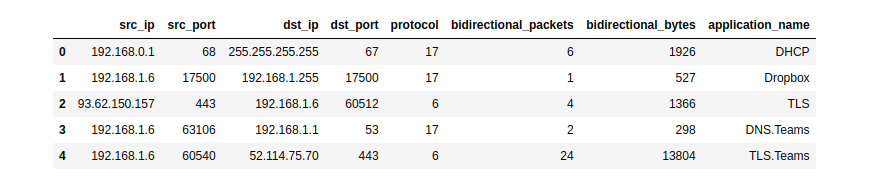
Pandas export interface
NFStream natively supports Pandas as an export interface.
# See documentation for more details.
# https://www.nfstream.org/docs/api#pandas-dataframe-conversion
from nfstream import NFStreamer
my_dataframe = NFStreamer(source='teams.pcap').to_pandas()[["src_ip",
                                                            "src_port",
                                                            "dst_ip",
                                                            "dst_port",
                                                            "protocol",
                                                            "bidirectional_packets",
                                                            "bidirectional_bytes",
                                                            "application_name"]]
my_dataframe.head(5)
CSV export interface
NFStream natively supports CSV file format as an export interface.
# See documentation for more details.
# https://www.nfstream.org/docs/api#csv-file-conversion
flows_count = NFStreamer(source='facebook.pcap').to_csv(path=None,
                                                        columns_to_anonymize=(),
                                                        flows_per_file=0,
                                                        rotate_files=0)
Extending NFStream
Didn't find a specific flow feature? add a plugin to NFStream in a few lines:
from nfstream import NFPlugin

class MyCustomPktSizeFeature(NFPlugin):
    def on_init(self, packet, flow):
        # flow creation with the first packet
        if packet.raw_size == self.custom_size:
            flow.udps.packet_with_custom_size = 1
        else:
            flow.udps.packet_with_custom_size = 0

    def on_update(self, packet, flow):
        # flow update with each packet belonging to the flow
        if packet.raw_size == self.custom_size:
            flow.udps.packet_with_custom_size += 1


extended_streamer = NFStreamer(source='facebook.pcap',
                               udps=MyCustomPktSizeFeature(custom_size=555))

for flow in extended_streamer:
    # see your dynamically created metric in generated flows
    print(flow.udps.packet_with_custom_size)
Machine Learning models training and deployment
The following simplistic example demonstrates how to train and deploy a machine-learning approach for traffic flow categorization. We want to run a classification of Social Network category flows based on bidirectional_packets and bidirectional_bytes as input features. For the sake of brevity, we decide to predict only at the flow expiration stage.
Training the model
from nfstream import NFPlugin, NFStreamer
import numpy
from sklearn.ensemble import RandomForestClassifier

df = NFStreamer(source="training_traffic.pcap").to_pandas()
X = df[["bidirectional_packets", "bidirectional_bytes"]]
y = df["application_category_name"].apply(lambda x: 1 if 'SocialNetwork' in x else 0)
model = RandomForestClassifier()
model.fit(X, y)
ML powered streamer on live traffic
class ModelPrediction(NFPlugin):
    def on_init(self, packet, flow):
        flow.udps.model_prediction = 0
    def on_expire(self, flow):
        # You can do the same in on_update entrypoint and force expiration with custom id.
        to_predict = numpy.array([flow.bidirectional_packets,
                                  flow.bidirectional_bytes]).reshape((1,-1))
        flow.udps.model_prediction = self.my_model.predict(to_predict)

ml_streamer = NFStreamer(source="eth0", udps=ModelPrediction(my_model=model))
for flow in ml_streamer:
    print(flow.udps.model_prediction)
More NFPlugin examples and details are provided in the official documentation. You can also test NFStream without installation using our live demo notebook.
Building from sources 


To build NFStream from sources, please read the installation guide provided in the official documentation.
Contributing
Please read Contributing for details on our code of conduct and the process for submitting pull requests to us.
Ethics
NFStream is intended for network data research and forensics. Researchers and network data scientists can use this framework to build reliable datasets and train and evaluate network-applied machine learning models. As with any packet monitoring tool, NFStream could be misused. Do not run it on any network that you do not own or administrate.
Credits
Citation
NFStream paper is published in Computer Networks (COMNET). If you use NFStream in a scientific publication, we would appreciate citations to the following article:
@article{AOUINI2022108719,
  title = {NFStream: A flexible network data analysis framework},
  author = {Aouini, Zied and Pekar, Adrian},
  doi = {10.1016/j.comnet.2021.108719},
  issn = {1389-1286},
  journal = {Computer Networks},
  pages = {108719},
  year = {2022},
  publisher = {Elsevier},
  volume = {204},
  url = {https://www.sciencedirect.com/science/article/pii/S1389128621005739}
}
Authors
The following people contributed to NFStream:
- Zied Aouini: Creator and core developer.
- Adrian Pekar: Co-creator and core developer.
- Romain Picard: MDNS and DHCP plugins implementation.
- Radion Bikmukhamedov: Initial work on SPLT analysis NFPlugin.
- Jorge Casajús-Setién: JA4 signature plugin implementation.
Supporting organizations
The following organizations supported NFStream:
- SoftAtHome: Supporter of NFStream development.
- Technical University of Košice: Hardware and infrastructure for datasets generation and storage.
- ntop: Technical support of nDPI integration.
- The Nmap Project: Technical support of Npcap integration (NPCAP OEM installer on Windows CI).
- Google OSS Fuzz: Continious fuzzing testing support of NFStream project.





Publications that use NFStream
More than 100 research papers have already used NFStream as part of their processing pipelines.
License
This project is licensed under the LGPLv3 License - see the License file for details